Policy-Based Incident Triage
Classify and route incidents by severity, on-call SLA, business impact, and ownership with deterministic escalation behavior so your on-call engineers stop guessing what to do next.
Solutions / Team
Incident triage, access requests, change control, infrastructure provisioning and service fulfillment all running with policy-driven automation, observable execution, and clear audit history.


1 hr
To go live with your first IT workflow
200+
IT systems you can connect
0
Manual handoff steps needed
Trusted by IT and infrastructure teams at leading organisations









Pick the IT process that generates the most manual work right now. Build it once on Unmeshed and every step runs with the right approvals, the right notifications, and a complete record of what happened.
When alerts fire at 2am, you need triage to happen automatically. Unmeshed ingests incidents from monitoring, ITSM, and alerting tools, classifies them by severity and business impact, and routes them to the right owner with escalation paths already defined.
Incident Intake, Classification, and Routing
Receive monitoring event
# step_1
Validate and enrich incident context
# step_2
Classify severity and service impact
# step_3
Route to on-call queue and set SLA
# step_4
Start SLA timer and send notifications
# step_5
Publish incident intake audit event
# step_6
Why Unmeshed Works Well for IT Operations
These platform capabilities help IT teams scale IT operations automation safely across incidents, identity operations, and change management workflows.
Classify and route incidents by severity, on-call SLA, business impact, and ownership with deterministic escalation behavior so your on-call engineers stop guessing what to do next.
Insert approval checkpoints for high-risk IT operations like privileged access, production changes, and emergency actions without breaking the automation flow around them.
Execute independent downstream tasks concurrently across ITSM, IAM, CMDB, and endpoint systems to reduce end-to-end latency in access and incident response.
Apply JavaScript steps for data normalization, policy exceptions, and environment-specific routing without missing critical controls or rewriting your whole workflow.
Use pause, resume, and controlled failure paths as first-class operational capabilities so priorities during incidents and maintenance windows are handled without manual intervention.
Track who approved what, which path was executed, and how outcomes were produced across every workflow run so evidence for compliance and SLAs is always ready.
Orchestrate access request validation, approval chains, provisioning, and automated revocation with explicit audit checkpoints at every step so nothing gets provisioned without the right evidence.
Clone proven workflow patterns for incident, change, onboarding, and renewal operations across business units so your IT standards actually get adopted rather than just documented.
Explore the full platform to see everything Unmeshed can automate for your IT operations.
AI Cost Efficiency
When Unmeshed runs an AI step in your incident triage, access classification, or change risk assessment, it uses exactly the token budget you configure. Every execution respects those settings.
Uncontrolled AI Execution
With Unmeshed
Token Limits Per Step
Configure max tokens on incident classification, change risk, and anomaly detection steps. Executions enforce the limit every time.
ai_step(
  model: "gpt-4o",
  max_tokens: 512,
  prompt: classify_incident_prompt
)
Executions Respect Settings
Every workflow run picks up your token configuration. No step runs outside the bounds you set regardless of how many incidents or requests come in.
AI Inside The Workflow
Severity routing, entitlement checks, and SLA assignment run deterministically. AI handles the ambiguous steps that genuinely need it.
Use these reference blueprints to kickstart IT workflow automation. Start with the one generating the most manual overhead right now.
Turn the Stripe, Shopify and internal webhooks about one order into a single record you can trust.
A nightly pull from every API source, cleaned and validated before it ever touches the warehouse, loaded as one governed write, and a Slack alert the moment anything actually breaks.
AI drafts and extracts, deterministic rules decide coverage and routing, plain code calculates the payout, and a human adjuster signs off on anything flagged or high value.
Approve routine expenses instantly with rules, use Claude only to read messy submissions, and send the rest to a human.
Why Unmeshed for IT
Built by the team behind Netflix Conductor and rebuilt for modern IT operations where incidents, access, change, and compliance all need reliable, auditable automation that doesn't create more work than it saves.
Connect your ITSM, identity, and monitoring tools and go live with a workflow in about 60 minutes without a full implementation project.
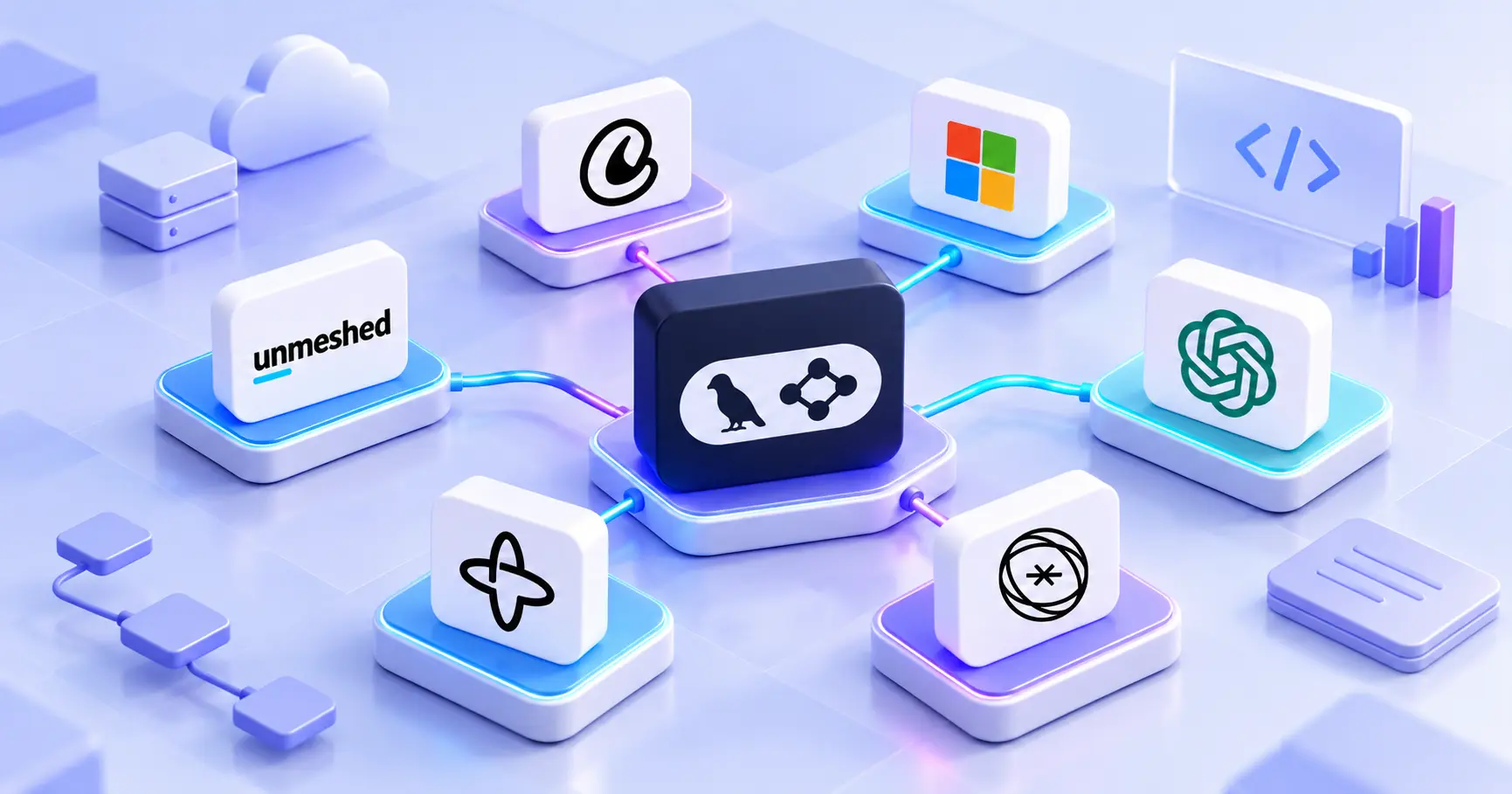
ServiceNow, PagerDuty, Okta, Jira, Datadog, Splunk and 200 more native integrations across your IT stack.
Incidents, access, change, JML, patching, service requests all running from one platform with shared visibility and consistent governance.
Keep routing and classification logic in decision steps so you can update escalation rules or approval thresholds without touching the underlying flow.
Every approval, escalation, and system action gets recorded with a timestamp and owner. Your compliance and security teams always have what they need.
Set response windows on any step and if no one acts in time, the next person in the chain gets notified automatically without anyone watching.
Integrations
Standardize IT operations with policy-driven workflows so every action is complete and manual runbooks become a thing of the past.
ITSM
ServiceNow, Jira Service Management, Freshservice, Zendesk
Identity and Access
Okta, Azure AD, Google Workspace, CyberArk, SailPoint
Monitoring and Alerting
PagerDuty, Datadog, Splunk, Grafana, New Relic
Infrastructure
AWS, Azure, GCP, Terraform, Ansible, Puppet
Communication
Slack, MS Teams, Email, Twilio, StatusPage
New integrations shipped every week
From the Blog
Pick one workflow that generates the most manual work right now. Build it on Unmeshed, go live in under an hour, then roll the pattern out across your IT operations.